
How 6 Team Games Played Out in a Single Session With 10 Players
Aug 7, 20266 min readJessica
Most event platforms specialise. Kahoot does quizzes. Mentimeter does polls. Jackbox does party games. If you want variety in a single session, you’re usually juggling multiple tools, asking your group to re-join each time, or picking one format and hoping people don’t get bored halfway through.
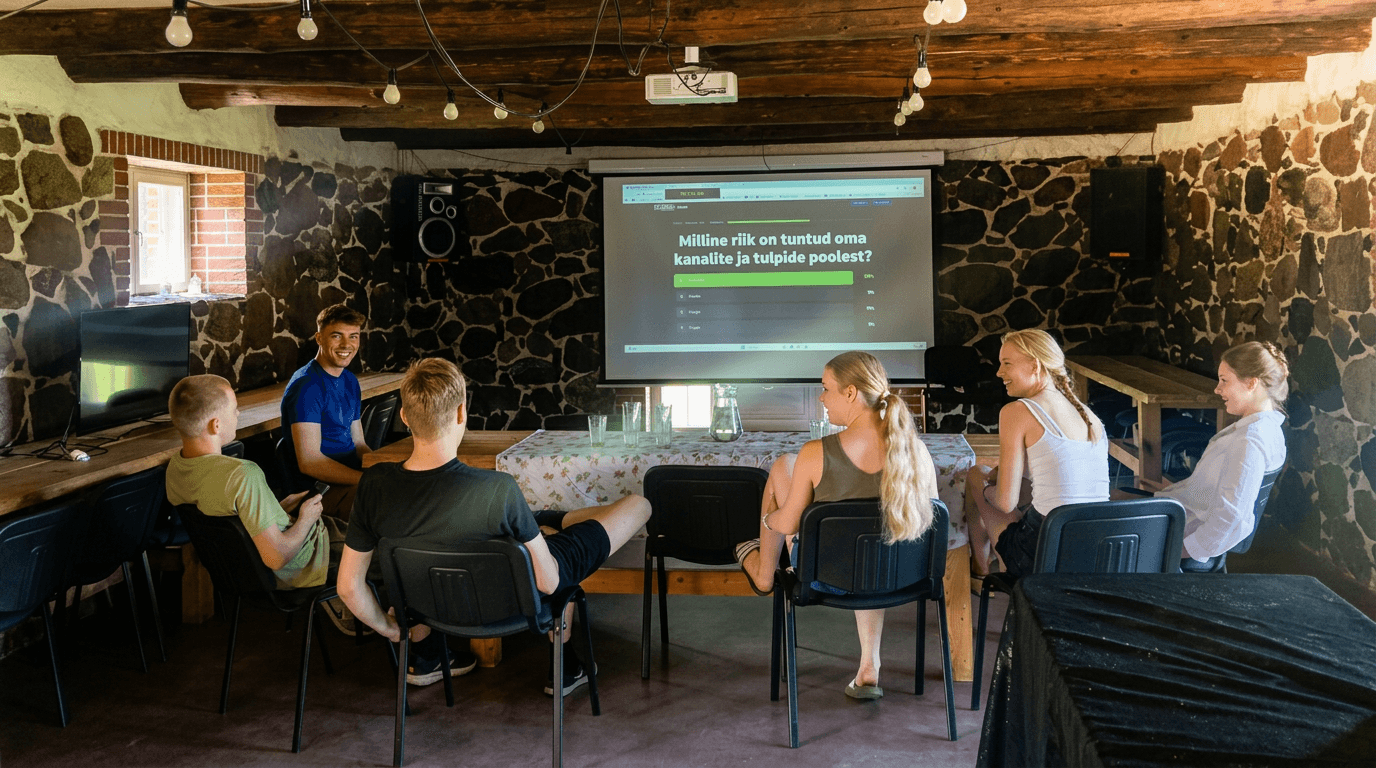
Kristofer Kallas didn’t have that problem. In a single evening with a group of about 10 recent high school graduates, he ran 6 completely different games – a fast team strategy game, an AI-generated trivia round, a competitive word game, a team word-chain, an emoji puzzle, and a rapid true-or-false quiz. All on the same platform. All in the same session.
That’s more games in one evening than most hosts run in a month. It also gave us something rare – a real, new comparison of how different game formats land with the same group in the same setting.
Here’s how each one played out.
The Setup
Group: ~10 people, recent high school graduates
Format: In-person, phone-based play
Games played: 6, over one evening
Order: Rock Paper Scissors → AI Quiz → Letter Storm → Word Loop → Emoji Guess → True or False
Kristofer’s overall take, in his own words: “I love the simplicity of the games and how easy it is to set them up.”

Game 1: Rock Paper Scissors
Kristofer’s take: “Really easy to start the game, and most of the people got the hang of it quickly. Everything worked well.”
Rock Paper Scissors – a fast, no-rules-to-explain team game where the room splits into sides and everyone votes on their phone. For a group that hadn’t played this together before, it did what a good opener is supposed to do: broke the ice, got everyone participating within 90 seconds, and set the tone for the rest of the evening.
The takeaway: Every session needs a low-stakes opener that requires no explanation. RPS is that game.
Game 2: AI Quiz – The First “Wait, This Is Cool” Moment
Kristofer mentioned: “AI Quiz was the second for sure – just wrote some topics down and the questions created by AI were super fascinating and engaging. And the hard mode was seriously hard, like it’s supposed to be.”
AI Quiz generates questions on any topic the host types in. For his group of recent graduates, Kristofer picked topics he knew they’d find interesting – the AI built the quiz from there. No question banks to prepare, no manual writing. He ranked it his second-favourite of the night.
The takeaway: The zero-prep model – type a topic, the game builds itself – is genuinely different from anything else in this space. Hosts don’t have to be trivia writers to run a great quiz round.
Game 3: Letter Storm – The Group Favourite
Kristofer’s top-ranked game of the entire session: “Letter Storm was the best! It was so competitive and fun.”
Letter Storm is a collaborative word-scramble format – coloured letters float across the screen, each colour representing a hidden word connected to a theme. Teams race to guess the words before they’re fully revealed. The early-guess mechanic rewards risk-takers, and the collaborative format means both loud shouters and quiet thinkers contribute to the score. (We wrote about the first test of Letter Storm – including the surprises of how well it scaled with bigger groups.)
The takeaway: Letter Storm was the highlight of the evening – the game the group would probably remember and want to play again. When a session has a mix of games, this is the one that becomes the anchor moment.
Game 4: Word Loop – The Solid Middle Round
Kristofer’s take: “Straightforward and easygoing game.” He also appreciated the flexibility: “Liked that you can choose different time for every round.”
Word Loop is a team word-chain game – a good rhythm game to run mid-session when the room needs something focused but not exhausting. It didn’t top Kristofer’s list, but it did exactly what a middle-round game is supposed to do: keep the momentum without asking too much of anyone.
The takeaway: Not every game needs to be a peak moment. Some need to be the connective tissue between the highlights.
Game 5: Emoji Guess – The Fast-Paced Puzzler
Emoji Guess drops emoji combinations on screen and challenges players to decode what they represent. Kristofer specifically liked one thing: “I liked that you can choose between 6 difficulty levels.”
That level of control matters when you’re running multiple games in one session. A quiz round can be adjusted for the group’s knowledge level. A puzzler can be adjusted for how sharp people are feeling after two hours of play. Games that give the host these dials are the ones that scale to different audiences.
The takeaway: Difficulty tuning inside a single game is what lets one platform handle both a group of quiz veterans and a group that’s just here to have fun.

Game 6: True or False
Kristofer’s take: “Really quick and people liked it.” He also flagged that the difficulty was very accessible, and appreciated the “good options to modify.”
True or False was a low-barrier format that requires no reading, no typing, just tapping. For a group that had been playing for a while and was starting to wind down, it worked because it demands almost nothing. Tap true or false. Watch the leaderboard shift. Do it again.
The takeaway: Every session needs something that keeps energy high without asking people to concentrate. True or False is designed for exactly that moment.
The Real Story: One Platform, Six Formats, Zero Tool-Switching
The most useful thing this session revealed isn’t about any single game. It’s about what it looks like to run a full evening with a group and never once switch tools.
Kristofer didn’t ask the group to download anything. Didn’t create separate accounts for different games. He picked a game, they played it, they moved to the next one. The transitions took seconds, not minutes. And because everything ran on the same platform, the group could focus on the games instead of on setup logistics.
Kristofer put it best: “I love the simplicity of the games and how easy it is to set them up.” That simplicity is the thing that made 6 games in one evening actually feasible. On a fragmented setup – Kahoot for the quiz, a separate app for the word game, another tool for the emoji round – the same session would have taken twice as long and produced half the momentum.
Try It With Your Own Group
If you’re thinking about running something similar – a team evening, a meetup – every game Kristofer played is available on Games for Crowds. All 29+ games are free during the current experimental testing phase.
And if you do run a session we’d love to hear how it went. Feedback from hosts like Kristofer directly shapes what we build next. Every observation, every “this could be better,” every “we loved this part” makes the platform better for the hosts who come after.